
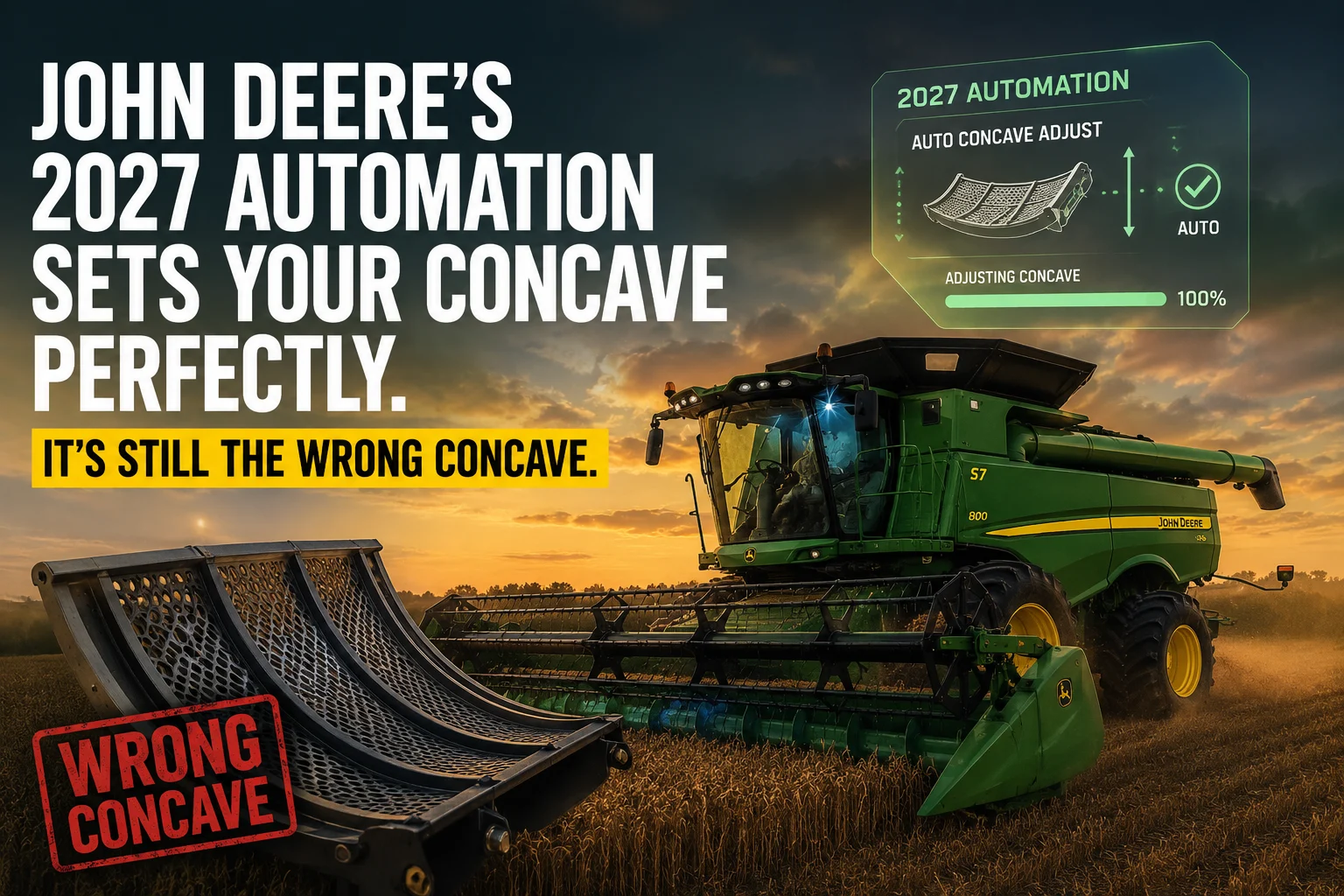
John Deere just announced its Model Year 2027 lineup for the X9 and S7 combines, and the headline feature is more automation than ever — including a system that automatically dials in your concave clearance based on crop type and geolocation. It’s a genuinely impressive piece of engineering. It’s also not the fix most farmers think it is.
If you run John Deere concaves, you’ve probably already heard the buzz about the 2027 model year. Automation is getting smarter, harvest windows are getting tighter, and Deere is putting more decision-making in the hands of software than ever before. But here’s the question nobody at the launch event is asking out loud: what happens when the software makes a perfect decision about an undersized concave?
That’s the gap this article is going to walk through — what John Deere’s new automation actually does, what it was never designed to do, and why more farmers are pairing that automation with aftermarket concaves instead of relying on clearance settings alone.
What John Deere Actually Announced for 2027
Model Year 2027 Combine Update — Key Points
- Announced February 2026 for the Model Year 2027 X9 and S7 combine lineup
- Harvest Settings Automation now auto-sets concave clearance, fan speed, rotor speed, sieve clearance, and chaffer clearance based on combine model, crop type, and geolocation
- Crop coverage expands from corn, soybeans, wheat, barley, canola, and rice to also include lentils, peas, rye, triticale, oats, and sunflowers
- Predictive Ground Speed Automation and Harvest Settings Automation now work together for the first time, instead of operating independently
- New 35-foot unloading auger and larger optional grain tank on the X9
- Factory-ready mounting points for HarvestLab sensors
- Upgrade kits available for some earlier machines, letting owners add certain automation features without buying a new combine
To be clear: this is a real advancement, and it matters. An operator running a new S7 or X9 in 2027 will spend less time manually chasing concave clearance settings across field conditions, and that saves time during a harvest window that never seems to get any longer. Deere built this because farmers asked for it, and it solves a real operator problem.
But automated concave clearance and concave capability are two completely different things, and the difference between them is where a lot of avoidable grain loss quietly happens.
Clearance Is a Setting. Threshing Surface Is Hardware.
Here’s the distinction that matters. Concave clearance is the gap between the rotor and the concave — how tight or loose that space is set for a given crop. It’s a variable, and it’s the thing Deere’s automation is adjusting.
What clearance can’t change is the concave itself: how much threshing surface area it has, how the crop material actually contacts that surface, and how much capacity the system can handle before grain starts getting lost out the back. A stock OEM concave has a fixed amount of surface area and a fixed wire or bar spacing. Automation can find the best possible clearance setting for that concave — but it’s still working within the ceiling that concave’s design sets. If the ceiling is low, the smartest clearance setting in the world still hits it.
This is the same reason a sports car with a perfectly tuned computer still can’t outrun a bigger engine. The software can optimize what’s there. It can’t add displacement.
Automated Clearance vs. Aftermarket Concave Hardware
| What It Does | John Deere Harvest Settings Automation | Aftermarket Concaves (Estes XPR3) |
|---|---|---|
| Adjusts clearance in real time by crop and location | Yes | N/A — clearance is still operator/automation controlled |
| Increases threshing surface area | No — fixed by OEM concave design | Yes — up to 135% more threshing surface area vs. OEM |
| Raises combine capacity ceiling | No | Yes — up to 200% capacity increase reported by users |
| Addresses rotor loss from undersized OEM grates | Indirectly, within existing hardware limits | Directly — engineered for the 2–5 bu/ac typical rotor loss range |
| Works across multiple crop types without swapping parts | Yes, via software crop profiles | Yes — 143-disrupter-finger grate designed for all-crop use, no covers or bands |
| Requires a new combine or upgrade kit | Yes, for full functionality | No — retrofits existing John Deere S-Series, STS-Series, and X-Series combines |
The two aren’t competitors. They’re solving different layers of the same problem. Automation handles the operating decision. The concave itself handles the physical ceiling on what that decision can achieve.
Where This Actually Plays Out in the Field

Automation Alone
- Faster, more consistent clearance settings across changing field conditions
- Less operator guesswork and fewer manual adjustments during harvest
- Still bound by OEM concave’s fixed threshing surface area
- Grain loss from an undersized concave persists even with ideal clearance settings
- Capacity ceiling stays the same regardless of software
Automation + Aftermarket Concaves
- Same automated clearance benefits, applied to a higher-capacity concave
- More threshing surface area for the automation to work with
- Addresses rotor loss at the hardware level, not just the settings level
- Reported fuel savings around 0.9 gallons/acre and 1–3 MPH ground speed gains when paired with a higher-capacity concave
- Upfront investment in the concave upgrade, separate from any Deere automation package
Common Mistakes Farmers Make With the 2027 Automation Rollout
- Assuming automation replaces the need to evaluate the concave itself. Harvest Settings Automation optimizes clearance — it doesn’t audit whether your current concave has enough threshing surface for your acreage and crop mix.
- Judging performance only by how “smooth” the automation feels. Smoother operation doesn’t mean lower grain loss. A combine can run beautifully on settings and still be leaving bushels on the ground because of concave capacity, not clearance.
- Waiting for a new combine purchase to address concave performance. The 2027 updates apply to new X9 and S7 units and select upgrade kits — they don’t retrofit concave hardware. Farmers running current John Deere combines don’t need to wait for a new machine to upgrade the concave itself.
- Not re-checking grain loss after adopting new automation. A new clearance system changes how the combine behaves. It’s worth re-measuring loss in the field rather than assuming smarter settings automatically mean less loss.
- Treating concave clearance and concave capacity as the same lever. They’re adjacent, not identical. One is a setting you dial in every pass. The other is a hardware decision you make once per combine.
Frequently Asked Questions
Does John Deere’s 2027 automation replace the need for aftermarket concaves?
No. Harvest Settings Automation adjusts concave clearance, fan speed, rotor speed, and sieve/chaffer settings based on crop and location — but it operates within the physical limits of whatever concave is installed. It doesn’t add threshing surface area or raise capacity, which is what aftermarket concaves like the Estes XPR3 are built to do.
Can I add the Model Year 2027 automation to my current John Deere combine?
Deere has stated that upgrade kits will be available for certain machines equipped with earlier technology packages, allowing some higher-level automation features to be added without replacing the combine. Full functionality tied to specific hardware, like the new 35-foot unloading auger, is limited to new Model Year 2027 units.
What’s the difference between John Deere concaves and aftermarket concaves?
John Deere concaves are the OEM grates built into S-Series, STS-Series, and X-Series combines. Aftermarket concaves, like the Estes XPR3, are engineered replacements designed to increase threshing surface area and capacity beyond OEM specifications, while remaining compatible with existing John Deere combine models.
How much grain loss are we actually talking about with undersized concaves?
Rotor loss from concave limitations typically falls in the 2–5 bushels per acre range, depending on crop, conditions, and concave setup. Over hundreds or thousands of acres, that adds up fast — and it’s a loss that clearance automation alone doesn’t resolve if the concave’s surface area is the limiting factor.
Will aftermarket concaves work with the new 2027 automation systems?
Yes. Aftermarket concaves like the Estes XPR3 are designed to fit within existing John Deere combine architecture, which means clearance automation continues to function normally — it’s simply optimizing clearance for a concave with more threshing surface area instead of the OEM grate.
Key Takeaways
- John Deere’s Model Year 2027 update expands Harvest Settings Automation to more crops and links it with Predictive Ground Speed Automation for the first time.
- That automation optimizes concave clearance — a setting — not concave capacity, which is a fixed hardware limit.
- Undersized OEM concaves can still produce 2–5 bushels/acre of rotor loss even with ideal automated settings.
- Aftermarket concaves like the Estes XPR3 address the hardware side of the equation, adding up to 135% more threshing surface area and up to 200% more capacity.
- Automation and aftermarket concaves aren’t competing solutions — they work best together, on current combines as well as new ones.
The Bottom Line
John Deere’s 2027 automation is a real step forward for operators, and it’s worth taking seriously. But it’s built to answer the question “what’s the best clearance setting for this concave, right now?” It was never built to answer “does this concave have enough surface area for what I’m asking it to do?”
That second question is a hardware question, and it’s the one aftermarket concaves are built to answer. If you’re running a John Deere S-Series, STS-Series, or X-Series combine and you’ve been chasing grain loss numbers that don’t add up even with dialed-in settings, the concave itself is worth a look before the next harvest window closes in.
See how the Estes XPR3 Concave System pairs with your John Deere combine to close the hardware gap automation can’t fix.