

1. Introduction
Soybeans are one of the most economically significant crops harvested worldwide, yet they remain among the most challenging to thresh without sustaining mechanical damage. Cracked or split soybeans — commonly referred to as “crackage” — result in dockage at the elevator, reduced market value, and increased susceptibility to spoilage during storage.
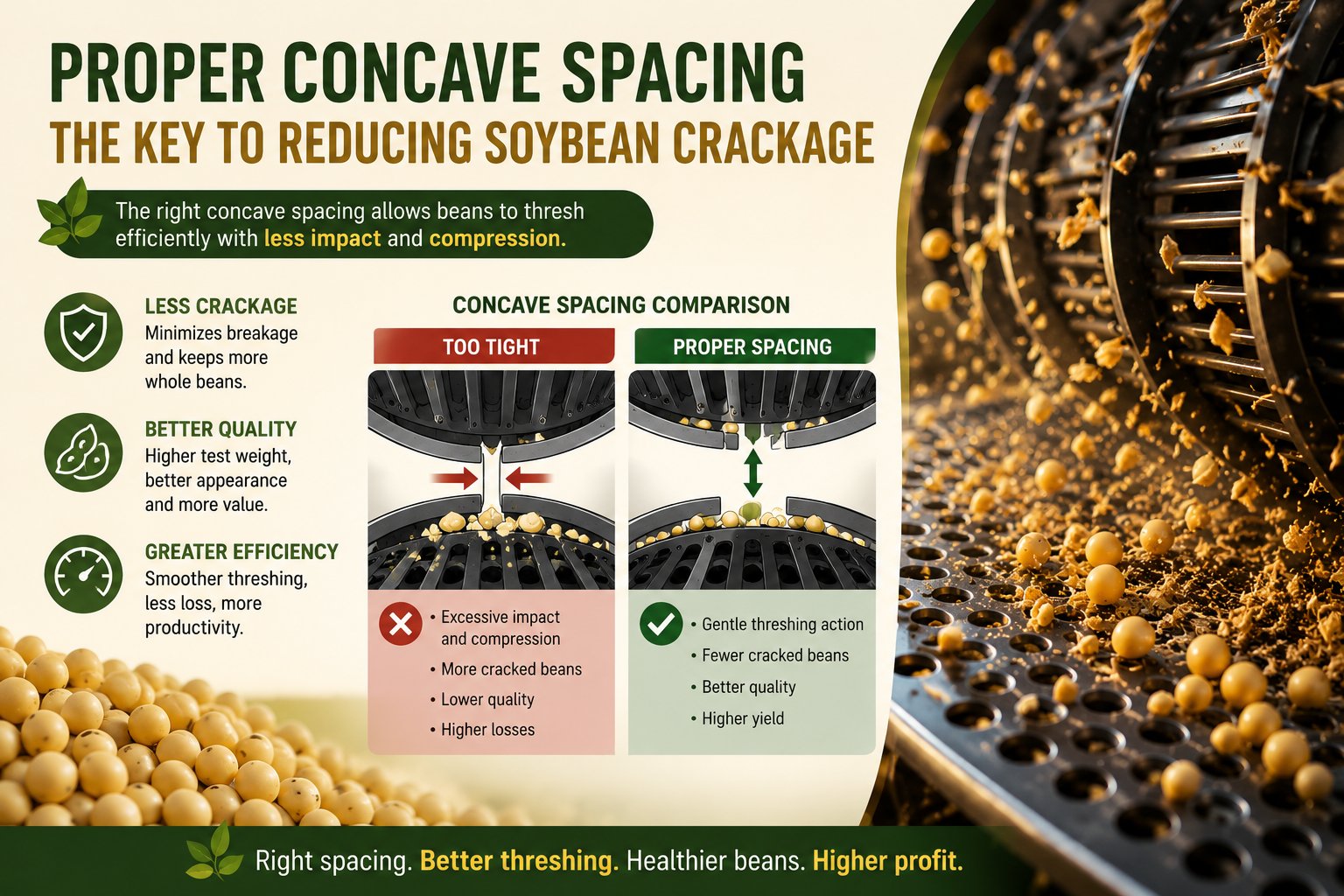
The combine concave is the primary threshing component responsible for either preserving or damaging soybean seed integrity. Improper concave spacing is consistently identified as the leading cause of excessive crackage during harvest. This article provides a comprehensive, practical guide to understanding, diagnosing, and correcting concave spacing to minimize soybean crackage and maximize grain quality and profitability.
2. Understanding the Soybean Threshing Process
In a combine harvester, soybeans pass through the threshing system where they are subjected to mechanical force between the rotating cylinder or rotor and the stationary concave beneath it. The goal is to separate the bean from the pod without splitting or cracking the seed itself.
Soybeans are uniquely vulnerable during threshing for several key reasons:
- They have a brittle seed coat that fractures easily under excess mechanical pressure
- Their moisture content at harvest directly determines how much force is needed to shell them cleanly
- Over-threshing (too much contact) cracks the bean, while under-threshing leaves beans in the pod
- Unlike corn or wheat, soybeans offer a very narrow margin of acceptable threshing force
The concave spacing — the gap between the concave bars and the rotor or cylinder — is the single most critical variable in determining how much mechanical force is applied to the bean during threshing.
3. Why Crackage Happens: Root Causes
3.1 Concave Spacing Set Too Tight
When the concave clearance is too narrow, the mechanical pressure applied to each soybean exceeds its structural tolerance. The seed coat splits, the cotyledons separate, and what should be a marketable bean becomes a docked commodity. Even small reductions in concave spacing — as little as 1 to 2 millimetres — can dramatically increase crackage rates, especially in dry conditions.
3.2 Crop Moisture Content
Soybean moisture content is the most influential external factor in threshing performance. As soybeans dry below 12% moisture, they become increasingly brittle. At moisture levels below 10%, the seed coat is highly prone to shattering even with moderate threshing force. Harvesting in the early morning when ambient humidity is higher — and bean moisture is naturally elevated — is one of the most effective agronomic strategies for reducing crackage.
3.3 Cylinder or Rotor Speed Too High
Excessive rotor or cylinder speed amplifies the impact force on each bean as it passes through the concave. Even if the concave spacing is appropriate, high drum speed increases the velocity of impact, which contributes to seed coat fracture. Concave spacing and rotor speed must be calibrated together — they are interdependent variables.
3.4 Worn or Damaged Concave Components
Worn concave bars, broken wire segments, or unevenly worn surfaces create inconsistent threshing forces across the concave width. This leads to localized over-threshing in some areas and under-threshing in others. Worn concaves must be replaced or reconditioned before harvest to ensure uniform performance.
4. Proper Concave Spacing: Practical Guidelines
While manufacturer recommendations provide the starting baseline, real-world concave settings must be fine-tuned based on crop and field conditions. The following table provides practical guidelines for soybean concave clearance under varying harvest conditions:
| Condition | Bean Moisture | Recommended Clearance | Notes |
| Ideal Conditions | 12–14% | 10–16 mm | Start here; reduce if pods remain unthreshed |
| Dry Conditions | < 10% | 16–20 mm | Open concave; reduce rotor speed simultaneously |
| Tough/Green Pods | > 15% | 6–10 mm | Tighten carefully; monitor crackage closely |
| Mixed Maturity | 10–14% | 12–16 mm | Adjust to the majority; run slower |
| Late Harvest / Brittle | < 9% | 18–24 mm | Open as wide as possible; harvest at dawn |
Note: These values are generalised guidelines. Always consult your combine manufacturer’s operator manual for model-specific baseline settings, and adjust from there based on field observation.
5. Step-by-Step Concave Adjustment Procedure
Step 1: Start with Manufacturer Baseline
Before entering the field, set the concave clearance to the manufacturer’s recommended starting point for soybeans. For most modern combines, this is in the range of 10 to 16 mm at the front of the concave and slightly wider at the rear.
Step 2: Harvest a Test Strip
Harvest 100 to 200 metres and stop. Collect grain samples from the clean grain tank and examine them visually. Also inspect the unloaded straw and chaff for any unthreshed pods or loose beans — both are important diagnostic indicators.
Step 3: Evaluate Crackage
Take a 500-gram sample of grain from the tank. Count or visually assess the proportion of cracked or split beans. If crackage exceeds 0.5 to 1% (elevator dockage typically begins around 0.5%), open the concave by 2 mm increments until crackage is within acceptable limits. If pods are passing through unthreshed, tighten the concave by 2 mm increments.
Step 4: Re-evaluate Rotor Speed
Rotor speed changes should always accompany concave adjustments. As a general rule, if you open the concave, reduce rotor speed slightly. If you tighten the concave, you may need to increase rotor speed marginally to maintain threshing completeness. The two variables work together and must be balanced.
Step 5: Monitor Continuously
Field conditions change throughout the day and across fields. Moisture content in the morning differs from afternoon conditions. Hillside passes may deliver denser or lighter crop volumes. Continuously monitor grain samples, and be prepared to re-adjust concave spacing every one to two hours during harvest if conditions are variable.
6. Impact of Crackage on Grain Quality and Market Value
Cracked soybeans carry significant commercial penalties. Grain elevators and processors impose dockage — price reductions — when crackage levels exceed acceptable thresholds. The following consequences compound the financial impact:
- Dockage deductions: typically applied at 0.5% crackage and increasing sharply beyond 1%
- Increased risk of mould and mycotoxin development in storage due to exposed cotyledon tissue
- Reduced oil extraction efficiency at the crush facility, lowering processor yield
- Greater susceptibility to insect damage in storage bins
- Reduced germination rates if cracked beans are retained for seed
Even a 0.5% reduction in crackage across a 500-hectare soybean farm can represent thousands of dollars in recovered market value per season. The return on investing time in proper concave calibration is consistently high.
7. Advanced Tips for Minimising Crackage
7.1 Harvest Timing
Harvest soybeans early in the morning, when relative humidity is highest and bean moisture is naturally 2 to 4 percentage points higher than afternoon levels. This alone can reduce crackage significantly without any mechanical adjustment.
7.2 Variable Rate Concave Control
Modern precision agriculture combines offer automated or variable-rate concave control systems that can adjust spacing in real time based on crop flow sensors and grain quality monitors. If your combine is equipped with such a system, ensure it is properly calibrated for soybean threshing parameters.
7.3 Concave Type Selection
Round bar concaves are generally preferred for soybeans over wire concaves, as they apply a gentler rolling action to the grain rather than an abrasive rubbing action. Spike-tooth concaves are not recommended for soybeans. If your combine supports interchangeable concave systems, consider investing in a dedicated soybean concave configuration.
7.4 Rotor-to-Concave Levelness
An uneven or misaligned concave — one side tighter than the other — creates asymmetric threshing force and uneven crackage patterns across the crop width. Check concave levelness at the start of each season and after any significant impact or maintenance event.
8. Conclusion
Soybean crackage is largely a preventable problem. The vast majority of mechanical seed damage originates from concave spacing that is set too tight — often because operators fear leaving unthreshed pods in the field more than they fear elevator dockage. In reality, the financial cost of crackage almost always exceeds the cost of a small amount of field loss.
By understanding the relationship between concave clearance, rotor speed, crop moisture, and grain quality, operators can make informed, real-time adjustments that protect both the crop and the bottom line. Regular calibration, early morning harvesting, appropriate concave type selection, and continuous monitoring are the pillars of a low-crackage soybean harvest.
Investing in proper concave setup is not just a mechanical task — it is a farm management decision that directly determines the quality and market value of your soybean crop.